
Why Design-Build is Increasing In Popularity: Understanding the Surge
The construction industry is undergoing a structural shift in how projects are delivered. Design-build is no longer a niche alternative to traditional methods. It is rapidly becoming the dominant project delivery method across infrastructure, commercial, industrial, and mixed-use development.
This growth is driven by measurable performance outcomes. Faster delivery, lower cost growth, and unified accountability are reshaping how owners and developers evaluate risk, schedule, and return on investment.
A Shift in Construction Project Delivery
For decades, design-bid-build (DBB) served as the default delivery method. Under this model, design and construction are contracted separately and executed sequentially.
However, escalating costs, compressed development timelines, supply chain volatility, and increasing project complexity have exposed the limitations of siloed delivery structures. Owners now require models that prioritize integration, speed, and financial predictability.
Design-build has emerged as the response to these pressures.
Market Adoption and Growth: The Data Behind the Surge
Design-build’s expansion is supported by both industry forecasting and performance data. Independent research firms continue to project sustained growth across sectors as integrated delivery becomes more widely adopted.
Projections from FMI indicate that design-build construction spending is expected to reach over $500 billion by 2028, representing a significant increase from prior years.
What Percentage of Construction Is Design-Build?
According to the Design-Build Institute of America (DBIA), design-build now accounts for over 44% of U.S. construction projects. Forecasts indicate that design-build will represent nearly 47% of total construction spending by 2028, equating to approximately $2.6 trillion in spending between 2024 and 2028.
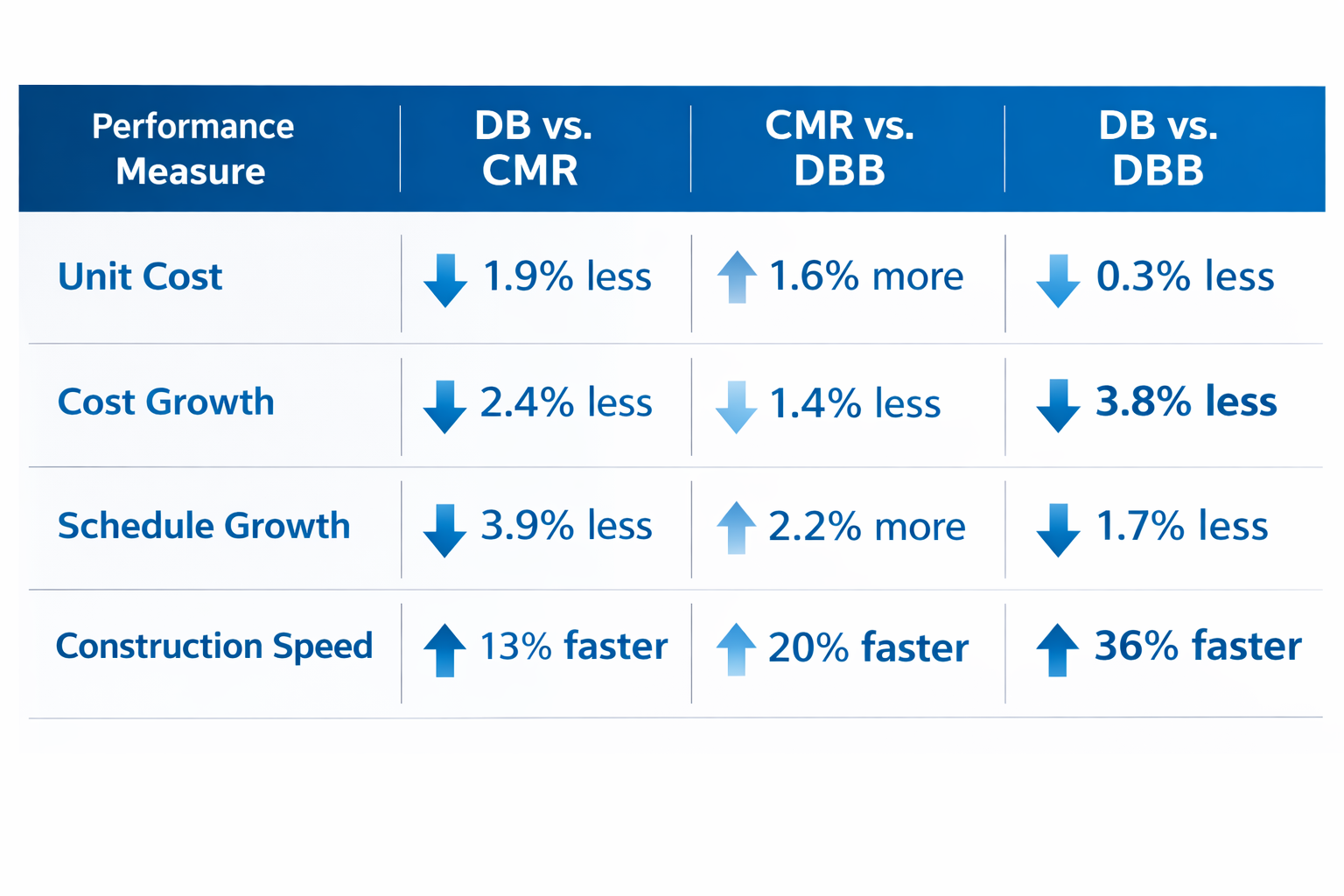
DBIA’s 2025 Design-Build Data Sourcebook further reports that design-build projects are delivered:
- Up to 102% faster than traditional design-bid-build
- 61% faster than CMAR
- With 3.8% less cost growth compared to DBB
Where Design-Build Dominates
Design-build adoption is strongest in sectors where complexity, schedule sensitivity, and capital exposure intersect. As performance data continues to validate integrated delivery, high-stakes project types are increasingly shifting toward unified procurement structures.
Infrastructure: Highways, Bridges, and Public Works
Public infrastructure operates under strict budget oversight and timeline scrutiny. Aligning design, pricing, and construction from the outset reduces schedule growth and cost escalation risk, making integrated delivery well-suited for transportation, utilities, and civic investments requiring complex coordination.
Commercial and Industrial Facilities
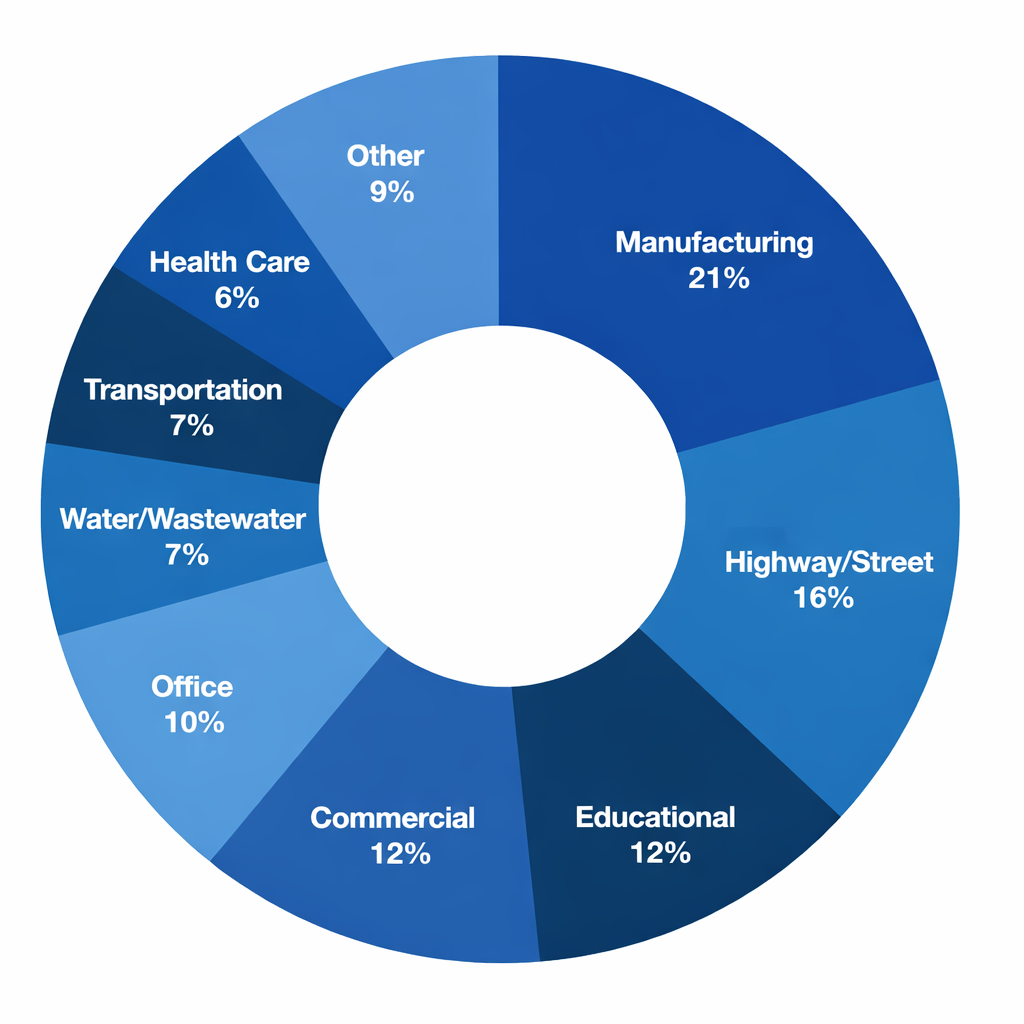 Manufacturing plants, distribution centers, and technically intensive facilities demand early coordination across structural and operational systems. Integrated delivery supports constructability validation during design, minimizing late-stage redesign and operational disruption as system complexity increases.
Multifamily and Mixed-Use Development
In residential and mixed-use projects, schedule certainty and cost stability directly influence pro forma performance. Coordinated trade sequencing and phased execution reduce redesign risk, supporting predictable lease-up timelines and financing performance.
Parking, Student Housing, and Hospitality
Projects tied directly to revenue timing are especially sensitive to delivery performance. Parking structures depend on structural efficiency and cost per stall. Student housing operates on fixed academic calendars. Hospitality developments rely on time-to-market alignment with brand and operational schedules. Integrated delivery strengthens coordination early, reducing schedule exposure and protecting return thresholds.
Other Time-Sensitive Sectors
Healthcare, data centers, and education facilities frequently operate under strict operational deadlines. Design-build’s integrated structure allows teams to manage fast-track schedules with fewer coordination-driven delays as performance demands intensify.
Understanding the Integrated Model Behind the Growth
Traditional design-bid-build separates design and construction into distinct contracts executed sequentially. Design-build integrates both the design team and the general contractor under a single contract and one accountable entity.
Design-build consolidates design and construction services within one unified team led by a design-builder responsible for delivery from concept through completion. This structure streamlines the project lifecycle, aligning design development, pricing, and construction execution from the outset.
By eliminating the disconnect between architect and contractor, design-build reduces coordination gaps, improves constructability review during design, and strengthens cost alignment early in the process.
The owner engages one primary entity responsible for coordinating both design and construction, simplifying oversight and centralizing accountability.
(For a detailed breakdown of how the design-build process works, see our complete guide to design-build construction.)
Why Traditional Delivery Models Are Losing Ground
Traditional design-bid-build separates design and construction into sequential contracts. As projects grow more complex and capital-intensive, that separation is increasingly viewed as structural friction rather than protection.
Owners are recognizing that late contractor involvement often leads to budget resets, change orders, and design conflicts discovered after pricing. In a market defined by escalation and schedule pressure, those inefficiencies are harder to absorb.
As financing tightens and timelines compress, the appetite for fragmented accountability and reactive coordination continues to decline. The shift away from DBB is less ideological and more practical. The structure no longer aligns with modern performance demands.
What Is Driving the Growth of Design-Build?
The expansion of design-build is outcome-driven. Owners are shifting procurement strategies because performance pressures have changed and are recognizing the benefits of design-build. The following factors are accelerating adoption:
- Faster Project Delivery
Overlapping design and construction shortens overall timelines. As developers place greater emphasis on time-to-market, capital velocity, and earlier revenue activation, procurement models that compress schedules are gaining traction. - Greater Cost Predictability
Escalation and post-bid budget resets have increased financial risk under sequential delivery. Design-build aligns pricing with scope earlier, reducing volatility. Owners are moving toward models that limit variance, not just initial price. - Reduced Change Order Exposure
Late-stage constructability conflicts are increasingly viewed as avoidable inefficiencies. Early contractor involvement mitigates downstream revisions, reinforcing confidence in integrated delivery. - Centralized Accountability
Divided responsibility between designer and contractor creates friction when issues arise. A single contractual framework reduces dispute risk, which is particularly attractive in capital-sensitive projects. - Improved Risk Alignment
As project complexity increases, fragmented decision-making introduces coordination gaps. Integrated teams provide clearer risk ownership before structural and financial commitments are locked in. - Better Fit for Fast-Track and Complex Projects
Healthcare, multifamily, institutional, and mixed-use developments increasingly require concurrent decision cycles. Design-build’s adaptability under compressed schedules is a key driver of sector-wide growth.
Design-build’s rise reflects a structural response to modern development pressures. Owners are not simply adopting a different model. They are responding to measurable performance demands.
Innovation Is Accelerating the Rise of Design-Build
Beyond structural integration, continued innovation is reinforcing the advantages of design-build delivery. Advancements in methodology and technology are strengthening coordination, improving predictability, and further compressing timelines.
Progressive Design-Build (PDB)
Progressive Design-Build expands flexibility by allowing owners to engage a design-builder during early preconstruction, collaboratively refine scope, and establish pricing before full construction authorization. This phased approach reduces uncertainty while preserving integrated accountability.
Industry data showing widespread engagement with Progressive Design-Build reflects growing demand for adaptable procurement models that maintain performance alignment.
Building Information Modeling (BIM)
Building Information Modeling enhances coordination through intelligent 3D modeling, clash detection, and real-time data integration. When embedded within an integrated delivery structure, BIM reduces rework and improves constructability validation during design rather than after bid.
Lean Construction Principles
Lean methodologies emphasize workflow efficiency, waste reduction, and continuous improvement. The collaborative design-build framework supports the cultural alignment required for Lean implementation to deliver measurable results.
Digital Tools and Data Analytics
Digital platforms, site monitoring technologies, and data analytics provide real-time project visibility and predictive insight. Integrated teams can identify performance risks earlier and adjust proactively, reinforcing the reliability that owners increasingly prioritize.
What the Rise of Design-Build Means for Developers
For developers, the growth of design-build reflects a broader shift in how projects are financed, structured, and delivered. Procurement strategy is no longer solely about construction execution — it directly influences capital exposure, schedule certainty, and market timing.
As integrated delivery approaches nearly half of U.S. construction spending, it is increasingly viewed as a baseline expectation in competitive markets. Developers who understand this structural shift can better align delivery models with pro forma assumptions, manage volatility, and protect return thresholds in fluctuating economic conditions.
The Industry Shift Is No Longer Optional
The rise of design-build as a project delivery method reflects a structural recalibration in how construction projects are delivered. Performance data, procurement behavior, and capital strategy alignment all point to integrated delivery as a durable market trend rather than a cyclical preference.
As complexity increases and capital sensitivity intensifies, delivery models that reduce volatility and compress timelines are gaining institutional support across both public and private sectors. The expansion of design-build is not driven by theory — it is driven by measurable outcomes that continue to influence how owners structure risk, schedule, and financial exposure.
FINFROCK: Leading Integrated Design-Build in Florida
FINFROCK has delivered more than 350 parking garages and 18 major vertical projects across Florida, including:
- 5 multifamily developments
- 5 hospitality projects
- 3 office and mixed-use developments
- 5 student housing communities
Across these markets, our design-build approach has helped developers accelerate delivery timelines, reduce cost growth, and bring revenue-generating assets online with greater predictability. From high-capacity parking structures to large-scale residential and mixed-use developments, our experience reflects a consistent focus on performance outcomes that align with today’s competitive development environment.
Position Your Next Development at the Front of the Shift and Build with FINFROCK.
The rise of design-build is not theoretical. It is being driven by measurable performance, capital efficiency, and faster time to revenue. As integrated delivery becomes the market standard, developers who align early are better positioned to control risk, protect returns, and respond to evolving demand.
If your next project demands schedule certainty, cost discipline, and coordinated execution, partner with a team that has been delivering integrated results across Florida for decades. Build with FINFROCK and position your next development at the front of the shift.