15 Benefits of Design-Build Construction for Commercial Projects
The Rise of Design-Build Construction
The benefits of design-build construction are driving one of the most significant shifts in the building industry today. As owners seek faster delivery, stronger cost control, and fewer points of friction, design-build has become the preferred project delivery method for commercial construction.
Unlike traditional design-bid-build, where separate contracts for design and construction often lead to delays and cost escalation, design-build construction unites architects, engineers, and builders under one team and one contract. This integration delivers tangible advantages — including accelerated schedules, predictable budgets, and improved communication throughout every phase. Design-build outperforms design-bid-build, having 102% faster delivery speed, 3.8% less cost growth, and 0.3% lower unit costs. When comparing other project delivery methods such as CMAR, having 61% faster project delivery, 2.4% less cost growth, and 1.9% ower unit costs.
According to the Design-Build Institute of America, nearly 50% of all United States Construction spending will be design-build by 2028. Design-build construction will represent up to 47% of non-residential construction spending by 2026. Today, owners recognize that the benefits of a design-build approach extend beyond cost and schedule. Integrated teams improve quality control, reduce risk, and offer clearer accountability from concept through completion. The result is a streamlined process where decisions happen faster, challenges are resolved earlier, and outcomes are more consistent.
As the construction industry evolves, these advantages continue to drive adoption across sectors. Manufacturing, highway/street, education, and commercial sectors have been projected to have the largest share of design-build spending through 2028 based on a new FMI report.
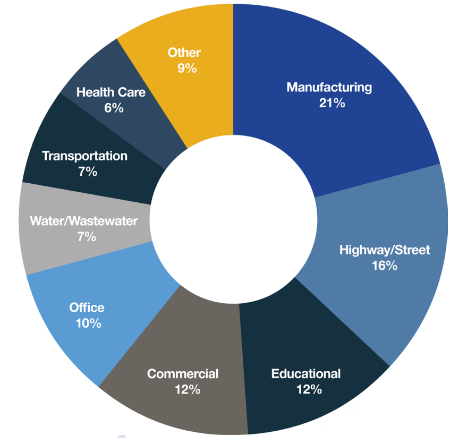
Image Source: DBIA.org
Let’s dive into the wealth of benefits that choosing a design-build firm offers.
What Are the Benefits of Design-Build Construction?
Design-build delivers measurable advantages that impact every stage of a project — from early planning to final turnover. Below are fifteen key benefits that make it one of the most effective delivery methods in commercial construction.
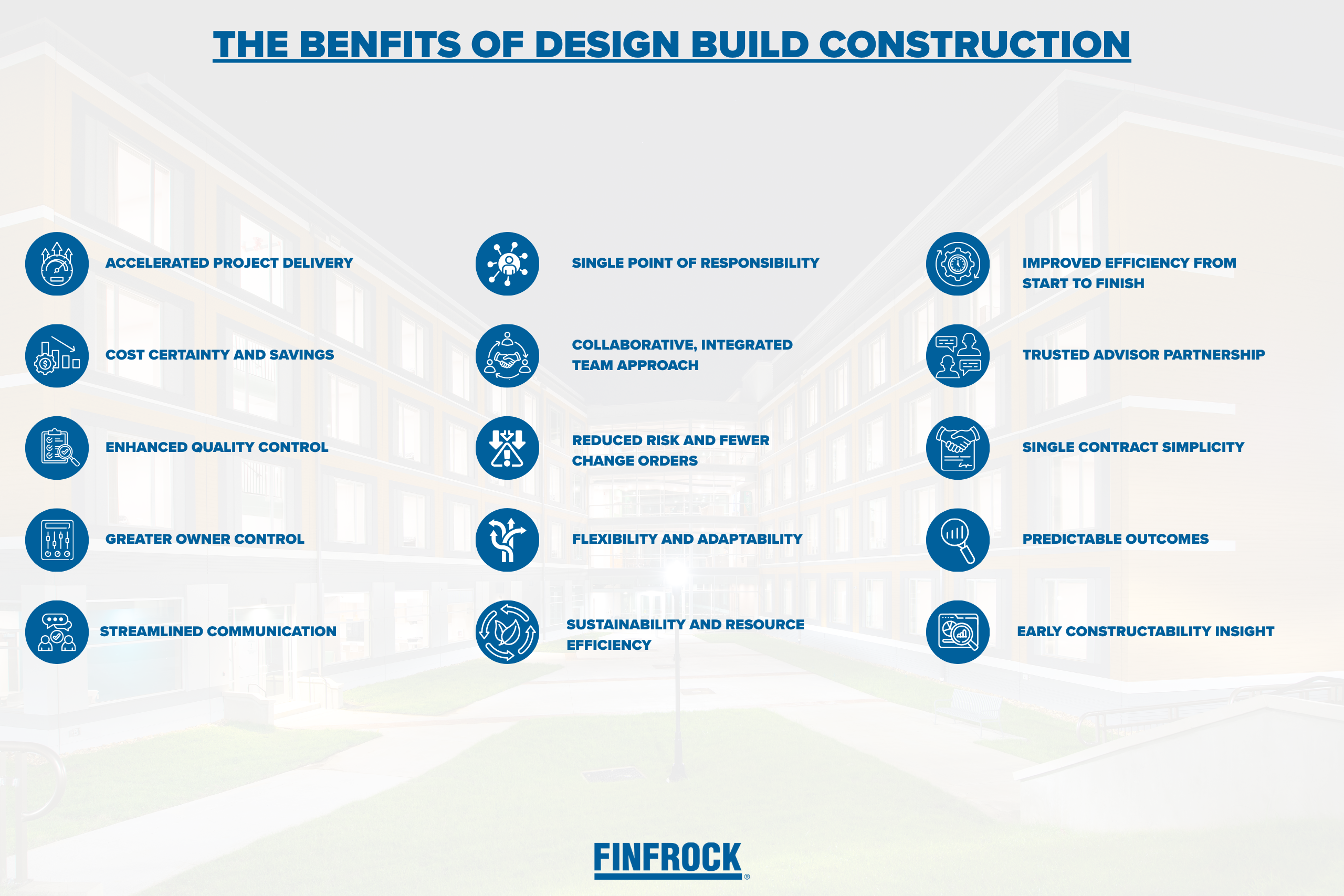
- Accelerated Project Delivery – Overlapping design and construction to shorten timelines.
- Cost Certainty and Savings – Establishing budgets earlier and minimizing unexpected expenses.
- Enhanced Quality Control – Maintaining consistency through unified design and construction oversight.
- Greater Owner Control – Keeping decision-making transparent and aligned with project goals.
- Streamlined Communication – Simplifying coordination through one connected project team.
- Single Point of Responsibility – Reducing confusion with one accountable source for design and construction.
- Collaborative, Integrated Team Approach – Bringing architects, engineers, and builders together from the start.
- Reduced Risk and Fewer Change Orders – Identifying potential issues early to prevent costly revisions.
- Flexibility and Adaptability – Allowing adjustments without disrupting budget or schedule.
- Sustainability and Resource Efficiency – Using materials and processes that minimize waste and energy use.
- Improved Efficiency from Start to Finish – Streamlining workflows across design, manufacturing, and construction.
- Trusted Advisor Partnership – Building long-term relationships based on transparency and performance.
- Single Contract Simplicity – Managing the entire project under one clear agreement.
- Predictable Outcomes – Delivering consistent performance on cost, schedule, and quality.
- Early Constructability Insight – Resolving buildability challenges before they reach the field.
Accelerated Project Delivery
One of the most recognized benefits of design-build construction is its ability to shorten project timelines. By integrating design, engineering, and construction under one team, design-build enables parallel progress instead of the traditional step-by-step handoff. Site work can begin while final drawings are being completed, permitting and fabrication can advance in sync, and decisions can happen in real time — all of which eliminate the delays common in design-bid-build delivery.
For owners, this efficiency means earlier occupancy, faster revenue generation, and fewer administrative bottlenecks. When the same team manages both design and construction, scheduling risks are reduced, and communication gaps disappear. The result is a streamlined process that keeps projects moving forward — often completing weeks or even months ahead of conventional timelines.
Cost Certainty and Savings
Design-build construction gives owners a clearer picture of total project cost much earlier in the process. Because pricing, design, and constructability are developed in tandem, the team can identify potential cost drivers before they escalate. Early collaboration between designers, engineers, and builders leads to more accurate estimates, value-driven design decisions, and fewer change orders once construction begins. This integrated budgeting approach allows owners to make confident choices that align with both their goals and financial parameters.
Beyond cost transparency, design-build often produces direct savings through efficiency. When coordination errors and rework are minimized, overall labor, material, and administrative costs decrease. The result is a delivery model that not only controls spending but also uses resources more strategically — ensuring that time, materials, and capital are invested where they add the most value.
Enhanced Quality Control
Design-build construction improves quality by ensuring that everyone responsible for the outcome — designers, engineers, manufacturers, and contractors — is part of the same team. This alignment allows design intent, engineering precision, and construction execution to stay consistent from start to finish. Because constructability and detailing are reviewed early, potential quality issues are caught before they reach the field, and materials or systems can be evaluated based on real performance, not just cost.
Centralized oversight also means accountability for quality doesn’t shift between firms. The same entity that designs the structure also builds it, maintaining control over specifications, tolerances, and workmanship throughout the process. The result is a higher standard of execution and fewer surprises during inspections or closeout — giving owners confidence that the finished building performs as intended.
Greater Owner Control
Design-build gives owners more influence throughout every phase of a project. With a single, unified team managing design and construction, owners are kept informed and involved in decision-making from concept to completion. Instead of waiting for separate design or bid phases, they gain access to real-time updates on costs, schedules, and materials. This transparency allows owners to make proactive choices that reflect their priorities — whether it’s accelerating occupancy, refining design features, or balancing aesthetics and functionality.
Because the process eliminates the competing interests of multiple firms, communication is streamlined and feedback cycles are shorter. Owners can approve design iterations, review budgets, and authorize changes within the same conversation, reducing delays and misunderstandings. The result is a project that stays aligned with the owner’s goals — delivered with the confidence that every decision is supported by accurate, integrated information.
Streamlined Communication
One of the core strengths of design-build construction is its simplified communication structure. Instead of managing multiple contracts and coordinating between separate firms, the owner works directly with one integrated team responsible for the entire process. This single-channel communication minimizes confusion, accelerates decision-making, and keeps everyone aligned on shared goals. With designers and builders collaborating from the start, information flows freely — reducing errors, misinterpretations, and costly back-and-forths.
This level of coordination also enhances accountability. Questions about cost, schedule, or design can be resolved within the same discussion, eliminating the delays common in traditional delivery methods. When architects, engineers, and construction managers communicate as one unit, the entire project benefits from clearer direction and faster response times, resulting in fewer setbacks and a smoother experience for the owner.
Single Point of Responsibility
At the core of design-build construction is a single source of accountability. Instead of juggling multiple contracts for design, engineering, and construction, the owner partners with one entity responsible for every phase of the project. This unified structure removes the finger-pointing that can occur when issues arise under traditional methods. The design-build team assumes complete responsibility for performance, cost, and schedule — ensuring a smoother path from concept to completion.
For owners, this means fewer administrative burdens and more confidence that every aspect of the project is being managed cohesively. When one firm is responsible for outcomes, there’s no disconnect between design intent and execution. Challenges are addressed directly, decisions are made faster, and accountability remains clear throughout the process. The result is a more efficient, transparent, and predictable experience for everyone involved.
Collaborative, Integrated Team Approach
Design-build thrives on collaboration. By bringing architects, engineers, and builders together under one contract, the model fosters early and continuous teamwork that traditional methods can’t match. Every stakeholder contributes insight from the beginning — designers understand construction constraints, engineers evaluate feasibility in real time, and builders provide cost and scheduling input before decisions are finalized. This unified process ensures that the entire team is aligned on both vision and execution.
The result is stronger problem-solving, fewer design revisions, and a shared sense of ownership across disciplines. When all project members work toward the same goals, solutions emerge faster and designs become more efficient and buildable. This integrated mindset not only improves performance but also builds trust among teams and owners — creating a more proactive, partnership-driven approach to delivering complex projects.
Reduced Risk and Fewer Change Orders
Design-build construction minimizes owner risk by consolidating accountability and resolving potential issues before construction begins. Because the design and construction teams work together from the start, cost, schedule, and scope are coordinated early — leaving less room for surprises. Problems that would typically emerge during bidding or construction are identified during design development, allowing for immediate adjustments and accurate forecasting. This proactive process dramatically reduces the likelihood of change orders and disputes later on.
Owners benefit from a smoother delivery experience with fewer disruptions and greater confidence in both cost and timeline. With one team responsible for design accuracy and construction performance, miscommunication and design gaps are virtually eliminated. The result is a more predictable project with fewer claims, reduced financial exposure, and a stronger sense of control throughout every stage of development.
Flexibility and Adaptability
Design-build construction offers owners and project teams the flexibility to adapt as priorities evolve. Because design and construction operate within the same framework, updates to layout, materials, or scope can be addressed collaboratively without causing major disruptions to budget or schedule. This responsiveness allows owners to make informed decisions later in the process — whether it’s refining interior design elements or adjusting functional requirements based on new data or tenant needs.
That adaptability also strengthens the project’s ability to respond to challenges. When market conditions, supply chains, or permitting schedules shift, the integrated design-build team can quickly evaluate options and implement solutions. This agility keeps projects moving forward while maintaining alignment with cost and quality goals — a critical advantage for complex, fast-paced commercial developments.
Sustainability and Resource Efficiency
Design-build naturally supports sustainable outcomes because all disciplines work together to optimize materials, energy use, and long-term building performance. Early collaboration allows sustainability goals to be integrated from the start — not added later as value engineering or design revisions. This means systems are designed holistically, ensuring structural efficiency, reduced waste, and minimal environmental impact. Manufacturers and builders can also coordinate to source materials responsibly and limit on-site waste through precision fabrication.
Beyond environmental performance, this approach often leads to operational efficiency and cost savings for owners. Buildings designed and constructed with sustainability in mind tend to perform better over time — lowering energy costs, improving occupant comfort, and supporting ESG or certification goals. By aligning sustainability with constructability, design-build makes it easier to achieve high-performance results without compromising schedule or budget.
Improved Efficiency from Start to Finish
Design-build construction streamlines the entire project lifecycle by unifying every stage under one coordinated workflow. From concept and permitting through fabrication and construction, teams work collaboratively rather than sequentially. This reduces downtime between phases, minimizes duplicated effort, and keeps the focus on progress instead of paperwork. When the same team handles design, manufacturing, and construction, tasks can overlap efficiently — accelerating completion without sacrificing quality.
This continuity also enhances communication, resource management, and scheduling accuracy. Issues that would typically cause rework or change orders are identified early, while design, budgeting, and construction decisions remain aligned from day one. The result is a leaner, more coordinated process where every step adds measurable value. Owners gain a smoother, faster experience — and a building that meets their expectations exactly as intended.
Trusted Advisor Partnership
One of the most overlooked benefits of design-build construction is the relationship it fosters between the owner and the delivery team. Because one entity manages design, engineering, and construction, the team becomes a long-term partner rather than just a contractor. This creates an environment of trust where transparency, collaboration, and shared goals drive every decision. Owners gain a partner who understands their priorities, anticipates challenges, and advocates for the project’s success from initial concept through completion.
This partnership also encourages continuous improvement across multiple projects. When the same integrated team supports an owner on successive developments, lessons learned are carried forward — improving efficiency, communication, and design innovation over time. The result is a relationship built on performance and accountability, not transactions. For owners, that means every new project starts on a foundation of experience, trust, and proven results.
Single Contract Simplicity
Design-build simplifies project management by consolidating everything under one contract. Instead of coordinating separate agreements for design, engineering, and construction, the owner engages a single entity responsible for all phases of delivery. This streamlined structure reduces administrative workload, shortens procurement timelines, and eliminates the disconnects that can occur between multiple firms. It also ensures that accountability for cost, schedule, and performance is clearly defined from the start.
With one contract guiding the entire process, communication and approvals become more efficient. Owners have a single point of contact for progress updates, design reviews, and construction milestones, making oversight more straightforward and transparent. This simplicity not only saves time but also minimizes potential disputes — allowing owners to focus on their project goals while the design-build team manages the details.
Predictable Outcomes
Predictability is one of the defining advantages of design-build construction. Because cost, schedule, and quality are managed by a single integrated team, there’s less uncertainty at every stage of delivery. Early collaboration allows for accurate budgeting, clear scheduling milestones, and proactive issue resolution — leading to projects that consistently finish on time and within budget. This reliability helps owners plan occupancy, financing, and operations with greater confidence.
Beyond timeline and cost performance, predictability also extends to quality and scope. With designers and builders aligned from day one, expectations are clearly communicated and design intent is preserved through construction. The result is a smoother process with fewer variables — one where outcomes are known, measurable, and repeatable across multiple projects.
Early Constructability Insight
Design-build gives owners a major advantage by incorporating constructability insight at the very start of a project. Because the construction team is involved during design development, plans are reviewed through the lens of feasibility, efficiency, and long-term performance. Potential conflicts or challenges — such as site constraints, material availability, or structural complexities — are identified and resolved before construction begins. This proactive coordination prevents rework, delays, and costly redesigns later in the process.
The early exchange between design and construction also drives innovation. Engineers and builders can recommend smarter sequencing, prefabrication strategies, or material alternatives that improve outcomes without inflating budgets. For owners, this means fewer unknowns, smoother construction, and a building that performs exactly as envisioned — all backed by the confidence that every design decision has been validated for real-world execution.
Applications of Design-Build
Design-build construction delivers measurable value across a range of commercial markets where coordination, speed, and cost certainty are essential. By combining design, engineering, manufacturing, and construction within one integrated team, owners gain the advantages of earlier pricing, fewer change orders, and a more predictable delivery process. Below are key sectors where design-build continues to enhance project performance and owner confidence.
Parking Garages
In structured parking, design-build enables early coordination between architecture, engineering, and precast manufacturing — producing garages that are durable, efficient, and tailored to site constraints. The ability to begin foundation work while components are fabricated off-site significantly reduces delivery time and minimizes disruption to adjacent facilities. Owners also benefit from integrated life-cycle planning that optimizes durability and maintenance costs over decades of use, maximizing ROI.
Student Housing
For university and college developments, speed and predictability are critical. Design-build allows teams to meet tight academic schedules by overlapping design and construction, ensuring facilities are ready before new terms begin. Early collaboration also helps balance cost, capacity, and amenities — creating functional, attractive living environments that remain financially viable for institutions and developers alike.
Multifamily
In multifamily projects, design-build streamlines coordination across design, permitting, and construction to shorten delivery timelines in competitive housing markets. Owners gain cost certainty early and avoid delays common to traditional contracting methods. Integrated design also ensures efficient layouts, improved sound control, and durable structures that perform for the long term. This supports faster lease-up and earlier ROI, maximizing multifamily investments.
Office and Mixed-Use Spaces
Mixed-use and office developments benefit from design-build’s ability to manage complexity across multiple program types. With design, engineering, and construction teams aligned, site utilization, parking, and building systems are optimized from the start. This approach reduces risk and provides owners with the flexibility to adjust plans as tenant needs evolve, ensuring the project remains commercially and operationally viable.
Hospitality
For hotels and resorts, design-build supports faster openings and more consistent quality across all finishes and systems. The integration of design and construction ensures that brand standards are maintained while keeping cost and schedule under control. Coordination between architectural design and manufacturing also streamlines MEP and structural integration — allowing high-end results to be achieved efficiently without sacrificing aesthetics or guest experience.
Case Studies and Real-world Examples Showing The Benefits of Design-Build
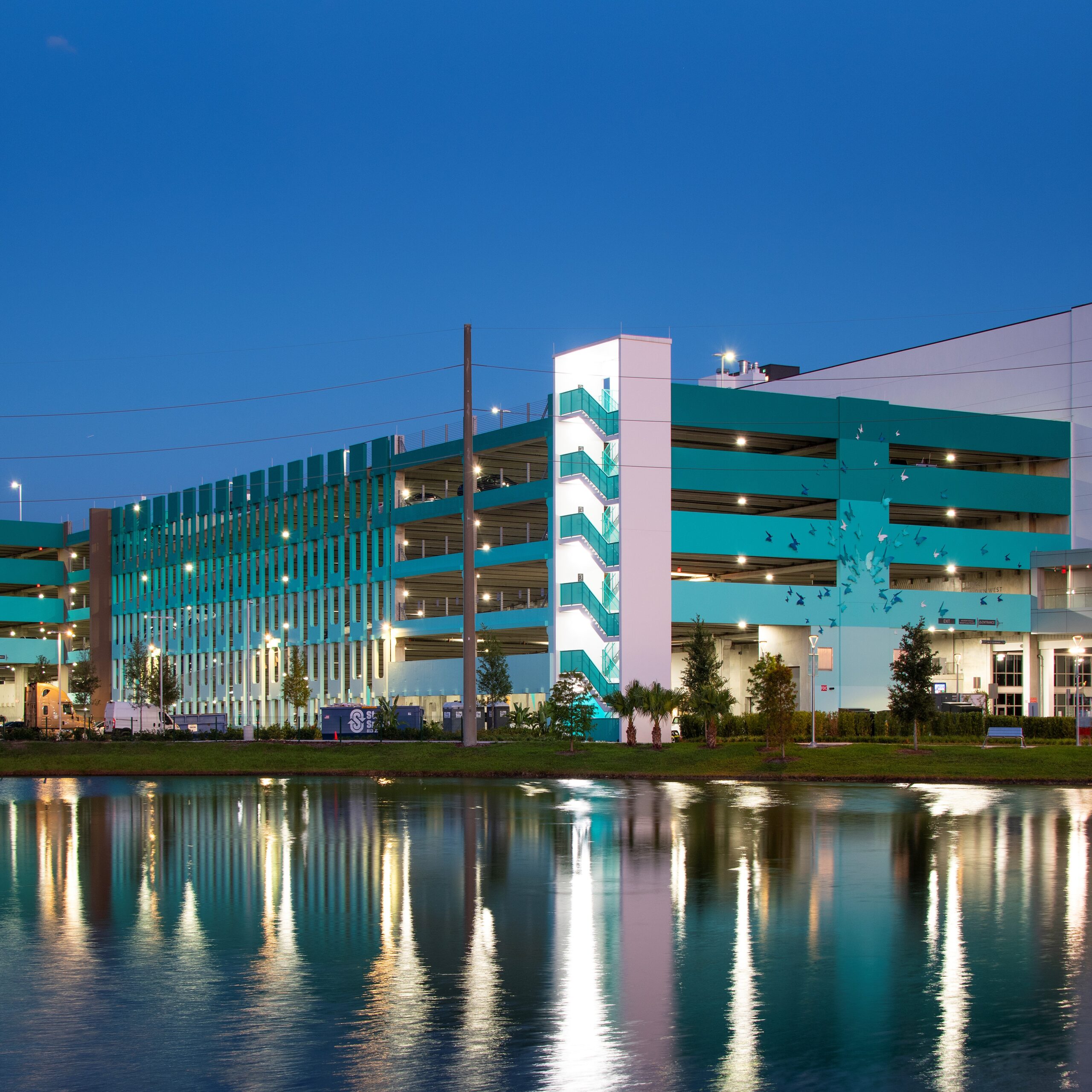 Midtown Megadeck
As part of Tampa’s 1.8 million-square-foot MidTown Tampa development, Bromley Companies and Barr & Barr Construction needed a parking solution that could serve multiple users across retail, residential, and hospitality spaces — all while staying on pace with an active construction site. To meet those demands, the team partnered with FINFROCK as the design-builder for MidTown Megadeck, a six-level, 1,250-space parking structure designed for both performance and future flexibility.
Through early design collaboration and shared parking analysis, FINFROCK identified opportunities to reduce overall parking demand by aligning usage patterns between tenants. This approach delivered substantial savings in initial construction costs while maintaining the capacity for future expansion to more than 2,300 spaces. Built alongside multiple ongoing projects and in coordination with two other architects, engineers, and general contractors, the Megadeck was completed efficiently and safely — providing a high-quality, scalable parking solution that supports one of Tampa’s most ambitious mixed-use developments.
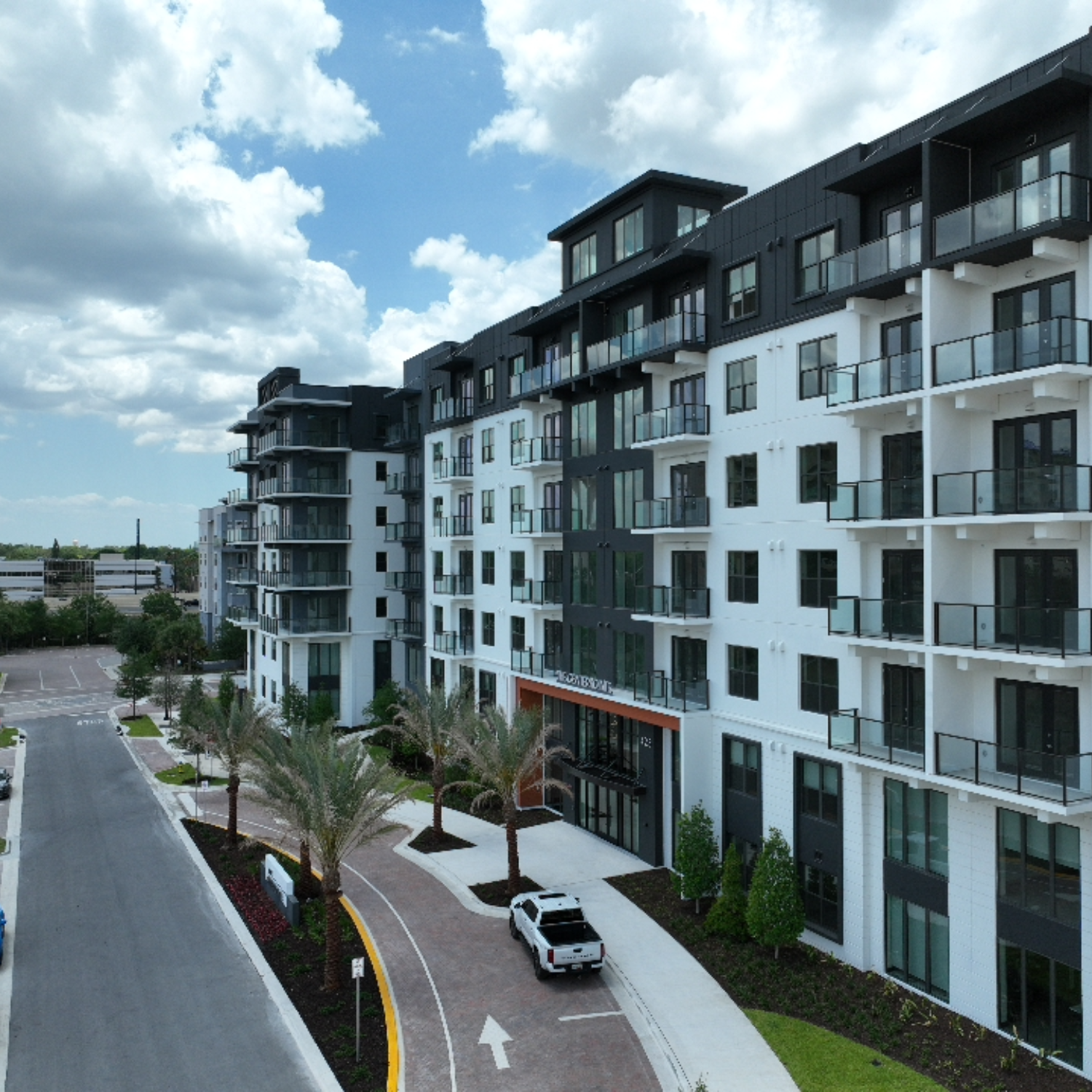
CenterPointe Apartments
When Emerson International set out to develop CenterPointe, a 401-unit luxury multifamily community in Altamonte Springs, the goal was clear: reach the multifamily market fast without sacrificing quality. To meet that challenge, Emerson partnered with FINFROCK — not just as a builder, but as an integrated design-build partner with deep development expertise and full control of the process.
Acting as architect, precast manufacturer, and general contractor, FINFROCK optimized every phase of the project — from early planning to completion. Upfront pricing, coordinated design, and locked-in scheduling gave Emerson the cost certainty and transparency needed to make time-sensitive financial decisions. Leveraging its proprietary DualDeck® building system, FINFROCK delivered the full structure in just over seven months, accelerating lease-up and generating earlier returns.
The project’s success underscored the financial impact of design-build integration: fewer coordination gaps, minimized risk, and a durable asset designed to retain value for decades. Today, CenterPointe stands as a cornerstone of Emerson’s 55-acre mixed-use vision — a project where speed, precision, and accountability converged to create long-term success.
Choose FINFROCK’s Unique Vertically Integrated Design Build Model to Maximize Benefits on Your Next Project
FINFROCK’s vertically integrated design-build model delivers more than efficiency — it provides complete control, accountability, and clarity from concept through completion. By combining architecture, engineering, precast manufacturing, and construction under one roof, we remove the barriers that slow projects down and create uncertainty. The result is a faster, more predictable, and transparent delivery process that consistently meets owner expectations.
From parking structures to large-scale mixed-use developments, our proven approach helps clients reduce risk, achieve early cost certainty, and bring their projects to market sooner. When you’re ready to experience how design-build can transform your next development, partner with the team built to deliver results — FINFROCK.